
Nurse vs Doctor may sound like the title of the next UFC fight, but this isn’t an article about the overwhelming dislike each profession has for the other. Besides, that’s something that is usually way overly exaggerated in tv and movies. Rather, the aim here is to outline the differences between the two—from education to philosophy.
Some people know what they want to do in life even when they are children. There are probably many nurses and doctors out there who always knew that’s what they were meant to do. But for most of us, it is a question that takes us a very long time to answer.
Many will never figure it out, and will drift through life in a profession they aren’t supposed to be in. Sure, they may be happy and the bills will get paid. But they will always have that feeling that something is missing.
The ultimate goal is to help people, of course. But each of us may arrive at that endpoint in a different way. Some of us are meant to be nurses, while others are better suited to be doctors. The differences between the two are vast, although some similarities do exist.
Education and Training
There are many differences in the type and amount of education a nurse and doctor receive.
Keep in mind that almost every type of program in the healthcare field will require pre-requisite courses, such as Biology, Chemistry, and Anatomy and Physiology. These courses can often take a year to complete in addition to the time any specific program may require.
Nurses have several options: LPN, RN, and Advanced Practice Nursing
LPN
To become a licensed practical nurse (LPN/LVN), one year of full-time coursework and clinicals is typically required. These programs are usually offered at vocational schools or community colleges. After completion of the program, you must then pass the NCLEX-PN to begin working.
Duties of the LPN can sometimes intersect the duties of a registered nurse (RN), and is often dependent on the state they are working in and the place of business. In many places, the administration of IV push medications is very limited for LPNs, especially when it comes to narcotics.
RNs are usually able to delegate responsibilities to the LPN, as well as ask for their assistance with certain tasks. However, this may not always be the case, as many LPNs work without direct supervision in certain settings. A prime example of this can be seen in home healthcare.
RN
There are two options for becoming a registered nurse (RN). The first option is to get your associate’s degree (ADN), which requires 2 years. This can be accomplished usually at community colleges, but also at many 4-year universities.
The other route is to get your Bachelor’s Degree in Nursing, which will require 4 years of training. You can enter into this program directly or after getting your Associate’s degree in a RN-to-BSN program.
Advanced Practiced Nurse
There are a plethora of options for nurses who want to advance their career, such as Nurse Practitioner, Nurse Anesthetist, and Clinical Nurse Leader. Many of these positions allow you to work autonomously with great independence. A Master’s degree is required, which usually takes at least two additional years after getting your BSN.
If you want to go even further, you can get a doctorate of nursing degree, which adds another two additional years after getting your MSN. These doctorate prepared nurses will often perform the same roles as those with an MSN, but it can open more doors to leadership roles.
Because of this option, it is possible to be a nurse and a doctor at the same time. Whoa…mind blown!
Doctors
Of course, doctors have several options as to which area of medicine they want to practice. For example, they could become a surgeon, intensivist, family practitioner, pediatrician, obstetrician, etc. The list goes on and on.
However, before they can pursue any of these areas of medicine, they will all have to complete some of the same tasks.
First, they need to get a bachelor’s degree that includes all of the courses required to get into medical school. Then, they must take the Medical School Admission Test (MCAT). After they get in, medical school is another 4 years. After graduation, another 3-7 years will be required to get into a specialty.
So it takes 1-4 years to become a nurse, 6-8 years to become an advanced practice nurse, and 8-15 years to become a doctor.
Roles in Healthcare
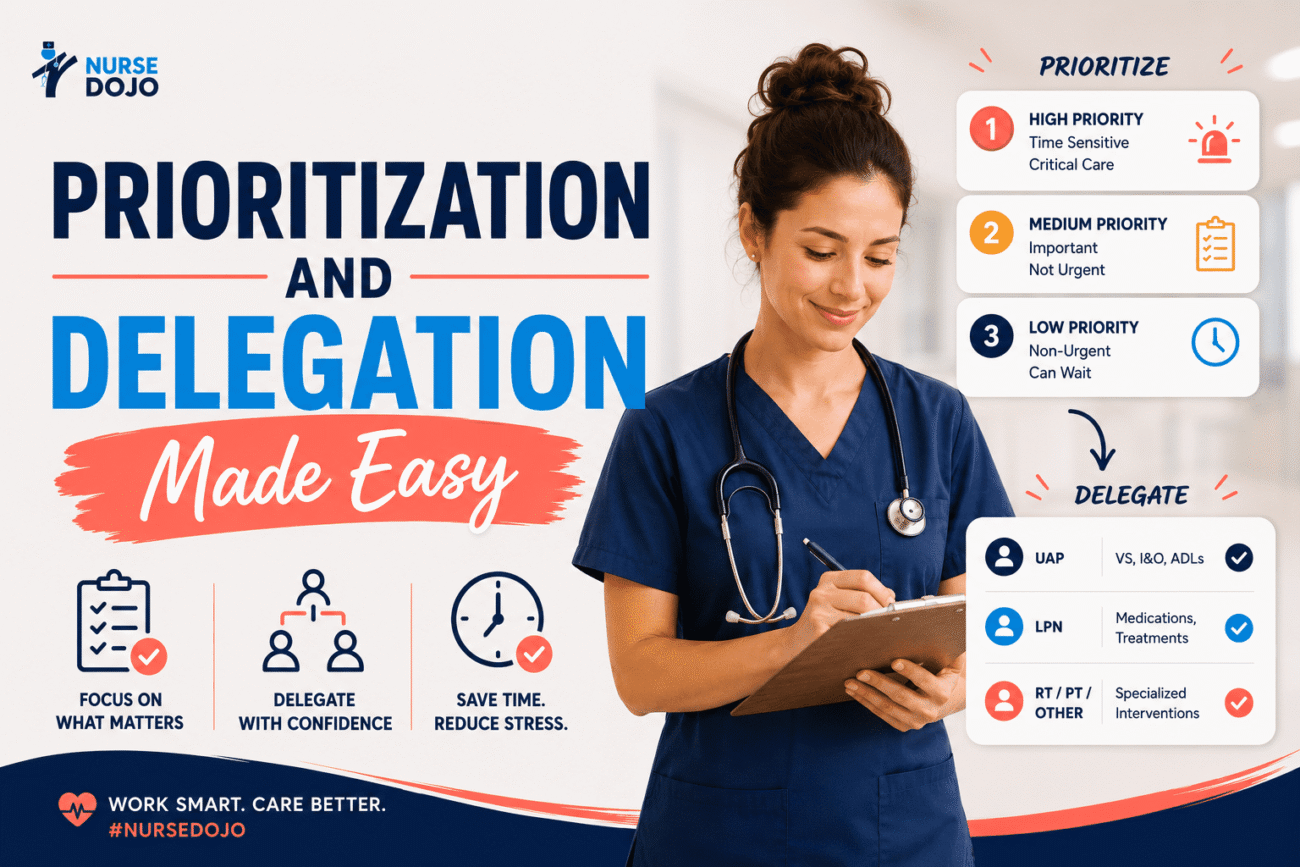
Depending on the type of nurse you are, your responsibilities and scope of practice may vary greatly. Registered nurses perform physical and neurological assessments on patients, administer medications, and perform certain procedures. They can also delegate some responsibilities to LPNs and CNAs (Certified Nursing Assistants).
Some things can be done without an order from the doctor. For example, assessments are done by the nurse without direction. A nurse in the ICU can usually start another IV without an order. Life-saving measures such as CPR obviously don’t need an order. Depending on the workplace, there are often standing orders, such as electrolyte replacement and blood pressure control.
Believe it or not, nursing isn’t all about taking doctor’s orders, though. In fact, a nurse should never blindly do what a doctor says. If that’s all they did, then school wouldn’t be required at all. They should think about every order they’re given. If they don’t agree with it, they can question it or even refuse to follow it. However, a good reason will be necessary if an order is refused. You can’t just refuse something simply because you don’t want to do it. Doctors make mistakes, but usually they have the patient’s best interests in mind.
Nurses tend to focus on the details of caring for the patient. While the priority remains solving the main problems a patient has, there are many ways of arriving to that end. Along the treatment journey, other things must be taken care of. The patient must get baths, dressings changed, maintenance medications given, etc. When these things are done, there is a certain way to do it only a nurse can deliver…from keeping the patient’s dignity while changing their clothes to being gentle as tape is pulled from their IVs.
Being a nurse is being able to talk patients, listening to their problems, while ignoring your own. It’s making a kid laugh as you make funny faces, not even noticing the shot you just gave them in their arm.
Only a nurse can code their patient, go eat lunch, and then come back early when they code again. It’s a nurse holding the hand of the patient as they take their last breath. It’s that same nurse who is hugging the family of that patient when they finally get the news.
Being a nurse is so much more than just giving meds, starting IVs, and putting in Foleys. It’s making a difference in the patient’s life as they heal.
That’s not to say that doctors don’t want to do all of these things. They just have different priorities and a lot more patients to take care of. They have to be able to quickly assess the patient and figure out what the problem is.
They don’t have the luxury of spending hours with every patient, so they have to make the most out of the time they do have. They arrive at a diagnosis and figure out ways to treat it, whether that be surgery, medication, or something else.
The bulk of the responsibility lies with the doctor, which is why so much time in school is required and why they get paid so much more. However, nurses are also held liable for their actions. If a patient decides to sue, it usually involves everyone who had a hand in their care. From doctors to assistants, everyone will likely be named in a potential lawsuit. Because of this constant threat, nurses and doctors are always charting things to cover their butts.
So which one is better?
Let’s get down to why you’re reading this: nurse vs doctor. Which one should you be? I wish there was a simple answer. I’m on the nursing side of things, so keep in mind that I’m probably biased. But I don’t think anyone can say that one is better than another. It all depends on what makes you happy and keeps you fulfilled.
I’ve never had the aspiration to become a doctor. It’s too much responsibility and usually requires too much of a time commitment. It’s just not for me. I’d rather be at my patient’s side, connecting with them on a more personal level.
But I’m sure there are many doctors who can never imagine being a nurse. A lot of prestige and respect comes with the title. They usually don’t have to bathe patients, clean bedpans, etc. They can see the patient, figure out the problem, and move on.
When you are considering which career path you may want to pursue, keep all of these things in mind. If you still aren’t sure, try calling some hospitals to see if you can shadow a nurse or doctor to see what they do first-hand.
Whatever you decide, make sure you are absolutely certain about it. It takes a lot of time and effort to become either a nurse or a doctor. It would be a shame to go through it all just to be miserable years from now.
No matter what, make sure it’s not about the money. It should be something you’re passionate about. Once you decide, keep your eye on the prize and never give up until you realize your dream. Good luck!